

A series of project updates and thoughts, but more important, dreams for where I would like these all to go next. I would love your conversations and project name suggestions and pointers at who might be interested in either collaborating or showing these works. I’ve marked where I would especially LOVE your input with ‼️, but of course, all comments are welcome.
(I’m back in SF until September, would love to say hi!)
Wearable Polarizers [name wip]
A long lived dream of mine has partially come true thanks to a makeathon in Seattle (Electric Sea) and getting a grant from them for materials. Back in 2022, I was doing undergrad research with Ticha Sethapakdi, who is an amazing artist as well, on polarizer animations. It didn’t go anywhere as a research project, but it was our dream to one day make clothing from this.
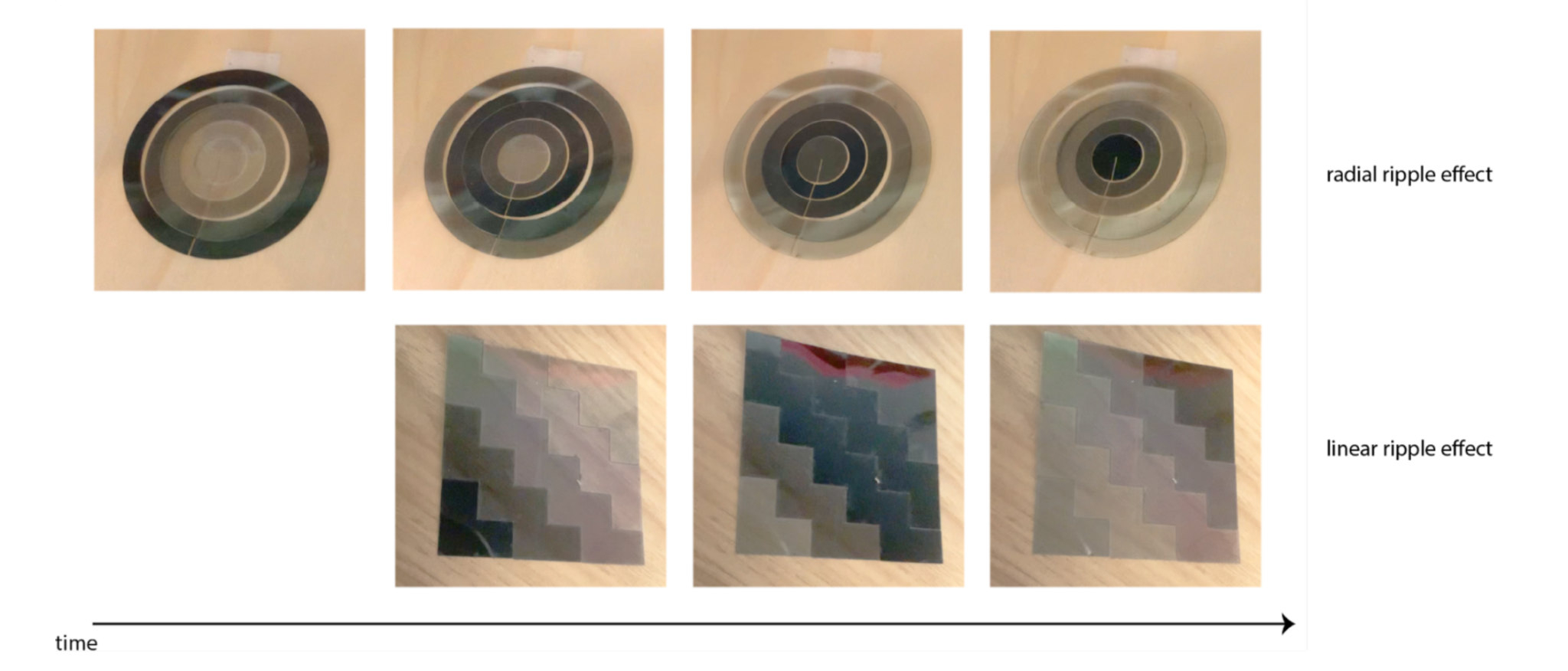
The hackathon went in all the ways a pressure cooker creative container does, with the laser cutter being down and my 3d printer being mean to me. I ended up hand cutting tiles and using a push pin to hand poke the holes to create the chain, leading to an unevenness that is just barely visible in a piece this small. But I did end up with a quarter of a top, and a proof of concept that conveyed the gorgeousness of this material. Polarizers work by only letting light through in one direction, so if you have two pieces of film at 90 degree angles, you effectively block all of the light, leading to the black sections. This top works by embedding that second layer in rotating glasses, so the patterns are revealed through the meeting of different angles. You could also wear regular polarized glasses and do extreme head tilting.
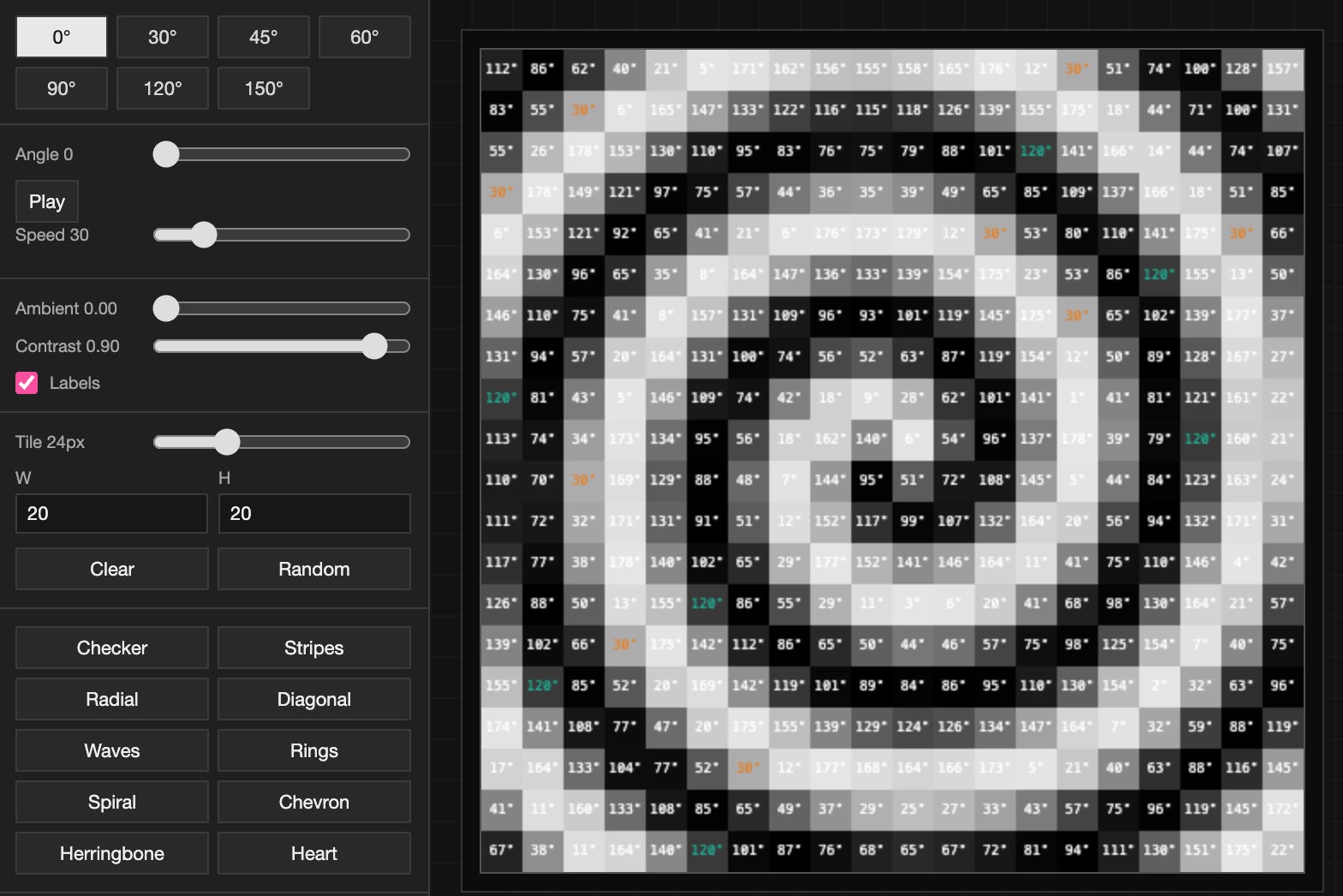
It’s still a dream to make a dress. I just have such a strong and beautiful vision of this flowing gown, with tiny tiles that animate in all sorts of ways. For this short hackathon, I did spin up a tiny tool to try to envision what final outputs could be, which I’ll iterate on for a more reliable fabrication method, most likely with laser cutters. This will be a labor of love, one that I’m not necessarily attached to doing alone, in case anyone predicts that they’ll have a great time assembling plastic tiles.
I’m reflecting on what it takes to give your dreams a chance at living, because at the end of the day the actual materials ended up being wayyy cheaper than expected and since I was also sleep deprived, I took it easy and did not work into the night on this. For an idea that has not left me for four years, it seems a shame that I didn’t give it a try earlier. It’s not the full length, wearable dress I envisioned, but it is the first realistic step towards that.
A poem: living& growing& dying… in London!


What a crazy turn of events! A poem: living &growing &dying will be at Voidspace Live in London (June 6-7) made possible thanks to a friend introducing me to a new friend who will help set it up as I won’t be able to make it. As a summary, it’s a site-dependent installation of apoem.life where passersby seed and grow poems, with the option to take poems home by printing them on a receipt printer. I’ve shown this installation twice before, once in Toronto, once in SF, both times with extreme panic and manic frenzied debugging to get it working after being struck by the curse of last-minute-change-before-exhibition-breaking-everything. It’s really not too complicated of a system, consisting of a receipt printer, a raspberry pi, a screen, and a computer mouse and I’ve made it so that it works on plug in, so that galleries can just turn it off and on again when something goes wrong. But thinking of someone else setting it up for me brings up so many other considerations that were surprisingly laborious to take into account, with the ultimate goal being that all they have to do is plug it in, without the manic debugging or god forbid, having to ssh into the pi and deal with git errors. I’m already sufficiently paranoid after the last exhibition, where we ended up in the surprising edge case where all the poems were gone! More poems printed than seeded, with none left to reseed the garden. Over the past two weeks I’ve been error-proofing my installation and updating it, making it work entirely locally to get rid of the wifi connection step, and with what I think is a really fun secret admin panel that comes up with the right sequence of clicks, like old mystery movies where knocking on the right bricks in order opens up the villain’s lair. All so that no extra elements have to be introduced (since a keyboard is not part of the exhibition) and everything can be done through clicking.
Through that, the person setting it up can set the time (without wifi, the pi has no idea what time it is!), adjust the size of individual elements (to prepare for different screen resolutions), and start the exhibition (wiping the database and starting the first few poems). I’ve added guards that the last poem cannot be plucked without first seeding a new one. I’ve prevented right clicks and added an instruction set. And yet, I’m sure there are things that are missing and this will be a learning opportunity. The exciting thing about all of these changes is that this installation is now able to be set up without me, and could potentially be shown in other places (with just plugging in two cables 🤞). If you know of any spaces that would love to show this type of work, I’d love your suggestions and introductions.
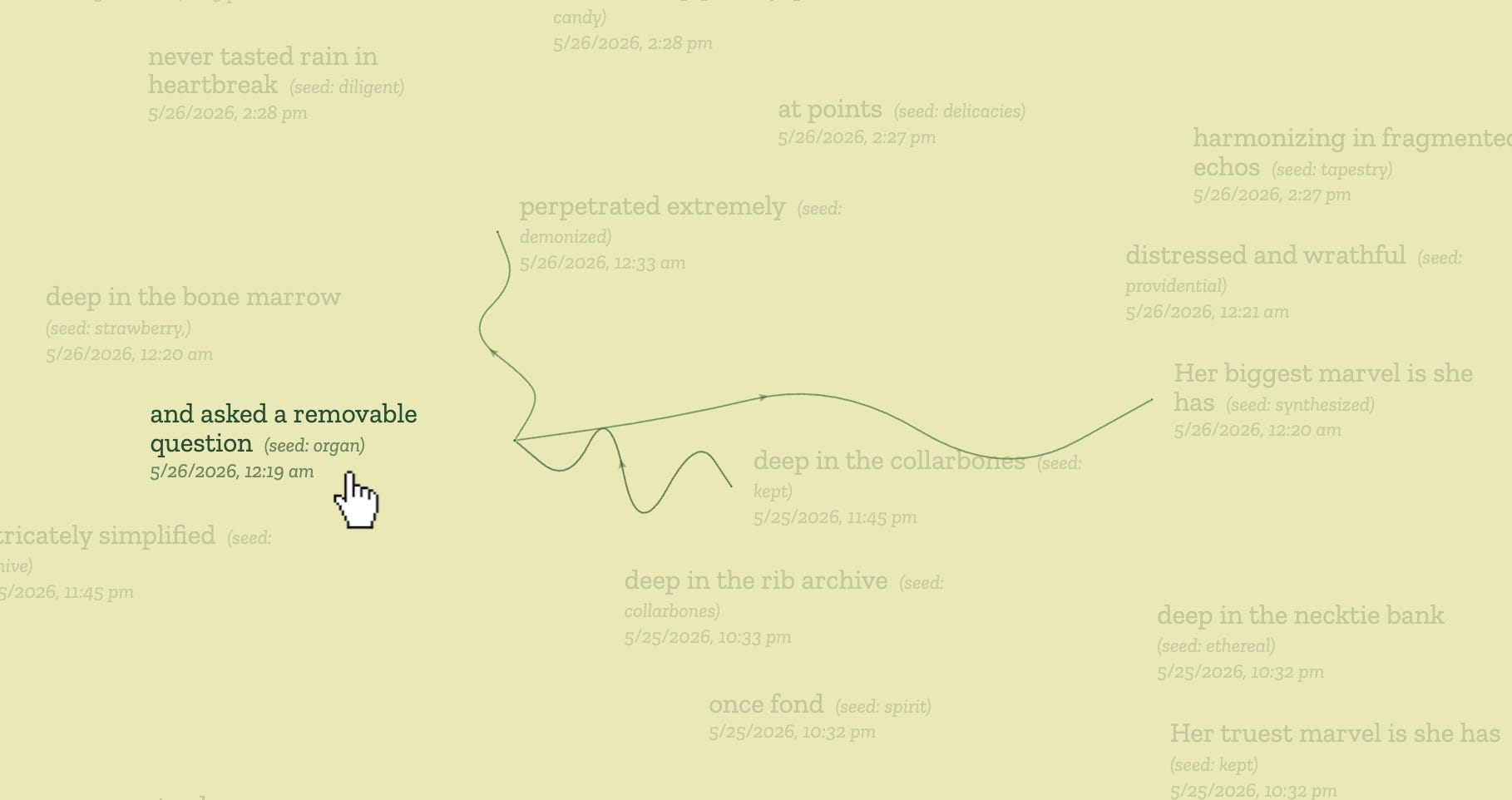
The other changes to the site include more types of poems (new grammars), more words that can act as seeds, dead poems having a few leftover seeds instead of using a random word, and a new and improved all poems page that shows the connections of lineage instead of just listing poems. In other words, many aspects of the original vision that I ended up running out of time for years ago when I was creating this for a magazine with a deadline. None of these are reflected in apoem.life, and I’m wondering if this should be a mirror for the installation, which has taken on its own life offline. In this way, the installation itself is also changing and growing over time, with each showing having something new and different, and I wonder what it might mean to see it decay as well one day.
In PhD Land
Speaking of, I will be in London a month after (July 10-17ish, lmk if you want to hang out! or know of cool events) for Creativity & Cognition, a cozy conference near and dear to my heart. I will be presenting work done with a dream team of collaborators, on workshops we ran last year asking, what metaphors we can use to think about governance of a community language model, created by writers, for writers. This project reflects a lot of my thoughts about AI, where it is incredibly difficult to separate a technology with the conditions of its creation. This is a hope for more optimistic futures, pointing at an alternative to total refusal where we can build this technology by our own conditions. We’re continuing the next phase of this project looking at how we might actually build this out with a small group of writers and what the governance might look like more concretely. If you are a creative writer interested in this, consider taking our survey ‼️ as we move towards the next steps.
I’m closing in on the end of my third year of the PhD and I can see how people say it passes by in a flash. It took this long to hit my stride, gaining more confidence in my research, both my taste and my ability to execute. I’m extremely opinionated, it turns out, which sometimes leads to slower research, but hopefully more fruitful results. The current project on process as an artistic material are detailed in a very short position paper here: Process as Poetic Provenance. The idea being that sometimes AI is used in writing, but there are no good ways of showing that as a process, especially one that feels like a part of the artistic expression rather than visualizations of data slapped on top of a text piece. But it extends beyond/without AI. Two pieces of writing, with two different processes and two different topics should not have the same process visualizations. From this, I think it will become possible to make it so that writers might want to share their process when they have more say, and it expresses something truly additional to the piece instead of feeling like an audit attached to their work. The space of designing this is truly wide and can risk being too open ended, but I am considering a method where I work with a set of 3-5 writers -- short form, ideally poetry or micro/flash fiction -- over the course of 2-3 months (if you’re curious… message me :))‼️
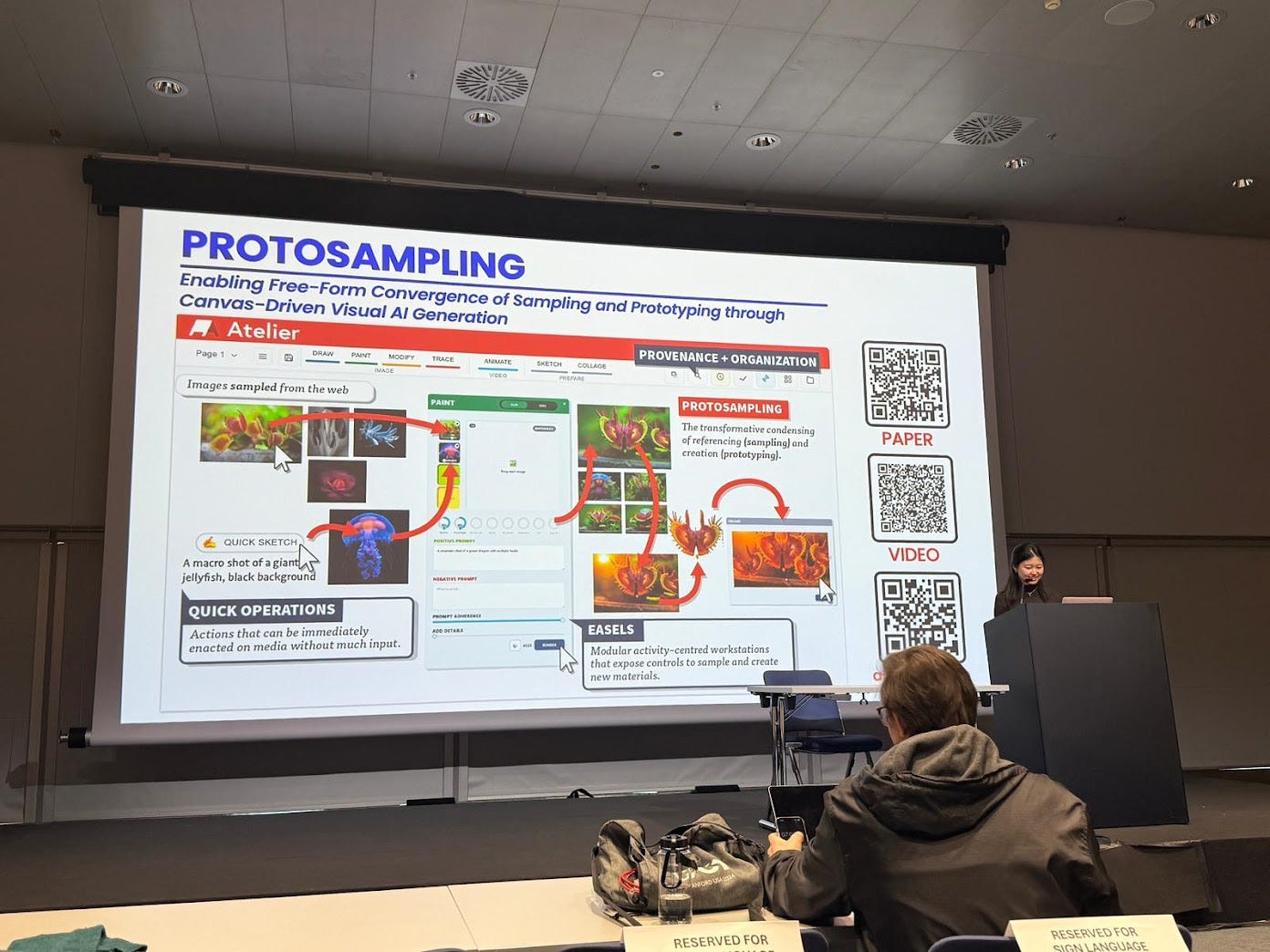
Barcelona for CHI (largest HCI conference) in April was a beautiful time, where I presented the idea of Protosampling (slides), the collapsing of that loop between sampling (gathering material for inspiration) and prototyping (making) that is occurring with increased speeds of generative AI. Sometimes getting work out in academia can feel extremely slow, with this work finishing at the end of summer last year, hitting the public stage almost half a year later. There are of course intermediates, but the general presence of paper takes the slow burn route. For this paper specifically, as model capabilities increase rapidly, many parts of the system look less impressive with each passing month and whilst preparing the talk I felt proud once again, because I think the core idea still holds, and in crazy daily viral AI demo land, that’s equivalent to passing the test of time. Looking at papers in this space is already a filter: if it has that nugget that is still true and compelling by the time it comes out, then it’s more likely to be a keeper.
I’m now in SF at Autodesk, thinking about the design space of video generation. I often come back to the Ted Chiang essay on why AI isn’t going to make art being that it is making decisions for you, and that art is ultimately about making a million little decisions, and I agree. If we’re saying this technology is the future then it better let me make those million little decisions still.
Computational Poetry + BOOK
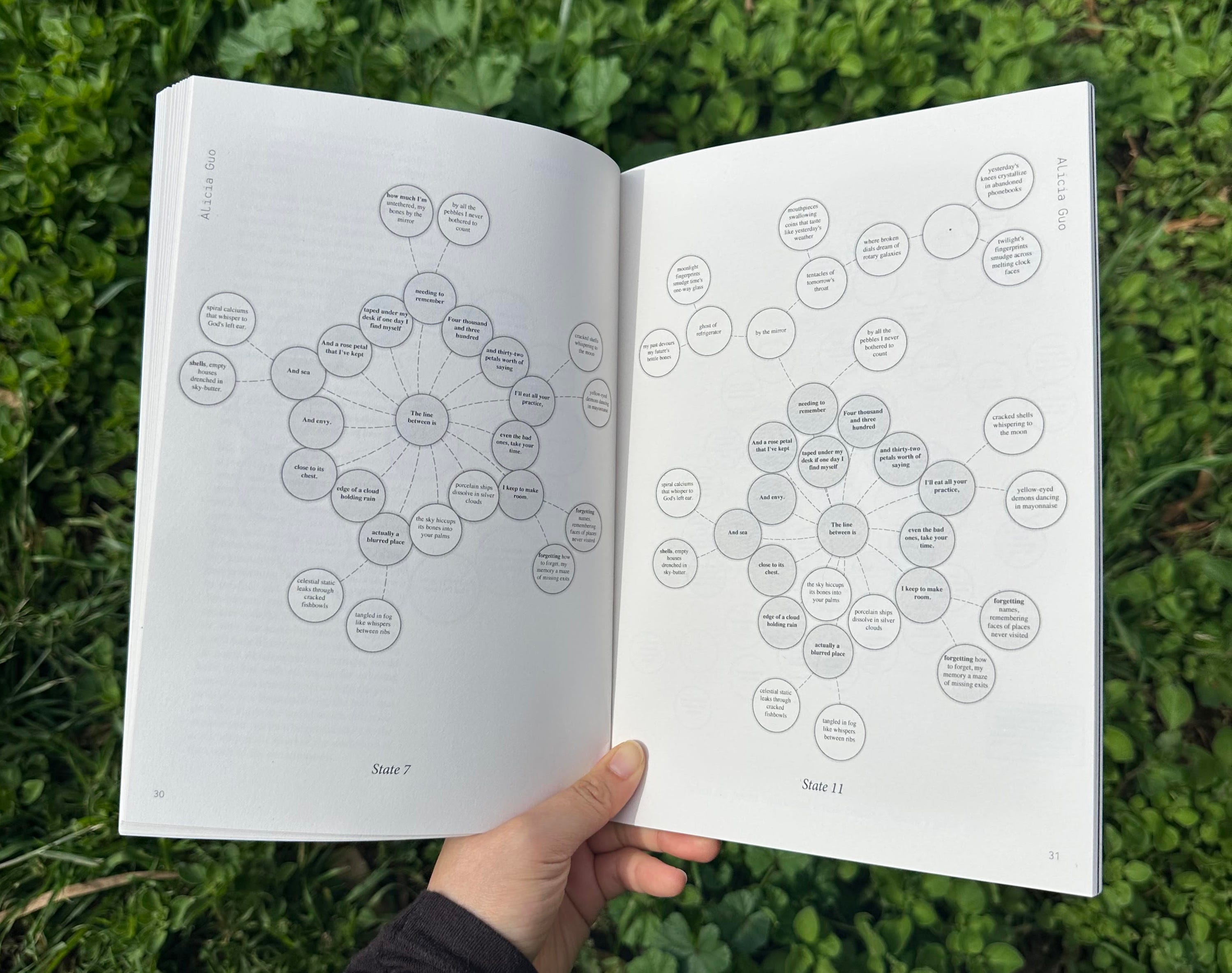
That primer/my talks on computational poetry is coming, I promise. In the meantime, I have a piece in Ensemble Park Issue 2 called Cephalopoet, an exploration of the scale of AI generation and constraint with a purposeful paring down of actions to just deletion. Each deletion generates two more nodes, like the Hydra. In this system, you are never able to edit every output. I’ll be doing a reading of this piece and talk more about the process of this and other metaphors for interactions on June 10.
What do we love more than a deadline? Nothing! I’ll be doing a performance/interactive talk at TIAT on poetry machines at the end of July. I would love a separate container to dive into the history of computational poetics, and right now am circling the idea of a new substack, where I can dive a bit deeper into the process behind some of my pieces, and also do more research/learn in public about other history in this space. This substack is my space to really just dump words and progress and serves that need well, but I’d love to have a space that forces me to write more essays. I really love the idea of Poetry Machines, any type of process (code or otherwise) that generates poetic material (text or otherwise), which has been central to all of my pieces: artifacts that allow others to create their own artifacts. The other name that’s been rolling around is Poemic (made up word), as a bit more of a catch-all for the vibe of things I do and think about, leaving the container a bit more wide open. ‼️‼️‼️
Poetry book has made a little progress, in that I’ve shared the idea with one friend now, and I’ve made a little tool to gather my fragments of writing. Other than that, it has been dismal, but I am now committed to having most of the material gathered by September because I’ll be doing a residency to tie up the concept.
Gray Area Incubator
Segue: that one conversation was so important to bring back momentum to the book. And I’m now doing the Gray Area Cultural Incubator program, where the value of talking to more people about your ideas has really been impressed upon me. I have never not learned something new about my project when opening up to a listening ear.
I have about two more months left to create this project, but the current trajectory is towards a coding language or visual tool that allows me to perform the equivalent of a poetry algorave (imagery left as an exercise for the reader, but if you do imagine it, please share). I am not very knowledgeable about algoraves or livecoding, send me your favorite links and people.‼️ The ultimate goal is to perform it, and learn the languages of mood and attention. I want to keep challenging myself into the spaces I am less comfortable in.
to be an ARTIST or a RESEARCHER
Another segue: the other part of this incubator includes programming on the different aspects of being an artist in the practical sense beyond creating the art (including portfolio, grants, getting feedback, maintaining connections, having a mentor etc) and it really feels like I have chosen two paths where one woman wears all of the hats. In both art and research you learn to fill every role yourself. I say two paths, because while they don’t feel entirely separate anymore, there is still a range and the two ends do not meet each other. A friend pointed out some examples of researcher-artists or artist-researchers and asked what is different and I think right now while there are places where the two meet and my research does influence my art and vice versa, there are so many more places that live in one or the other, and that’s not a thing that has to be fixed? I don’t have to force a combination, because I really enjoy the research I do and the art I do and in a perfect world that would be enough but I am running into the limits of legibility and that might just be a skill issue on my part. ‼️
Recently I had a conversation with friends about the overwhelming number of projects we all seem to be working on, of which must be shared before they can be exorcised from the mind, to clear the way for new projects. This has been my space for that, thank you immensely to all of the friends who are witnesses. I want to try something, where I post more frequently than I’m comfortable with on social media. A mind boggling truth that always re-boggles my mind is that you can post about a project more than once. And I’m terrible at that, but the feeling that compels me forward is the one where I feel like I am not doing my work justice by being shy. There are large projects that run the span of months to years. Some are one day experiments. I have not practiced how to give the former the space they deserve. So for the next month, until the next newsletter, I vow to be unhinged with my sharing.
shared:
a talk I gave on my work at SPC demo night
a friend and I have been passing our little custom tools back and forth. I love it so much, with not even a github repo. send me your tiny tools please.
wip:
for once, I think I’ve detailed updates on almost all of the most pressing projects, but I definitely want time for more tiny experiments ~~~
wait the figures in the governance paper are so CUTE people should do this more often
EXCITED FOR A MORE FREQUENT RATE OF POSTING!!!
i resonate so much with the artist-researcher / researcher-artist multiple hat-wearing conundrum... but be what you desire!!!